
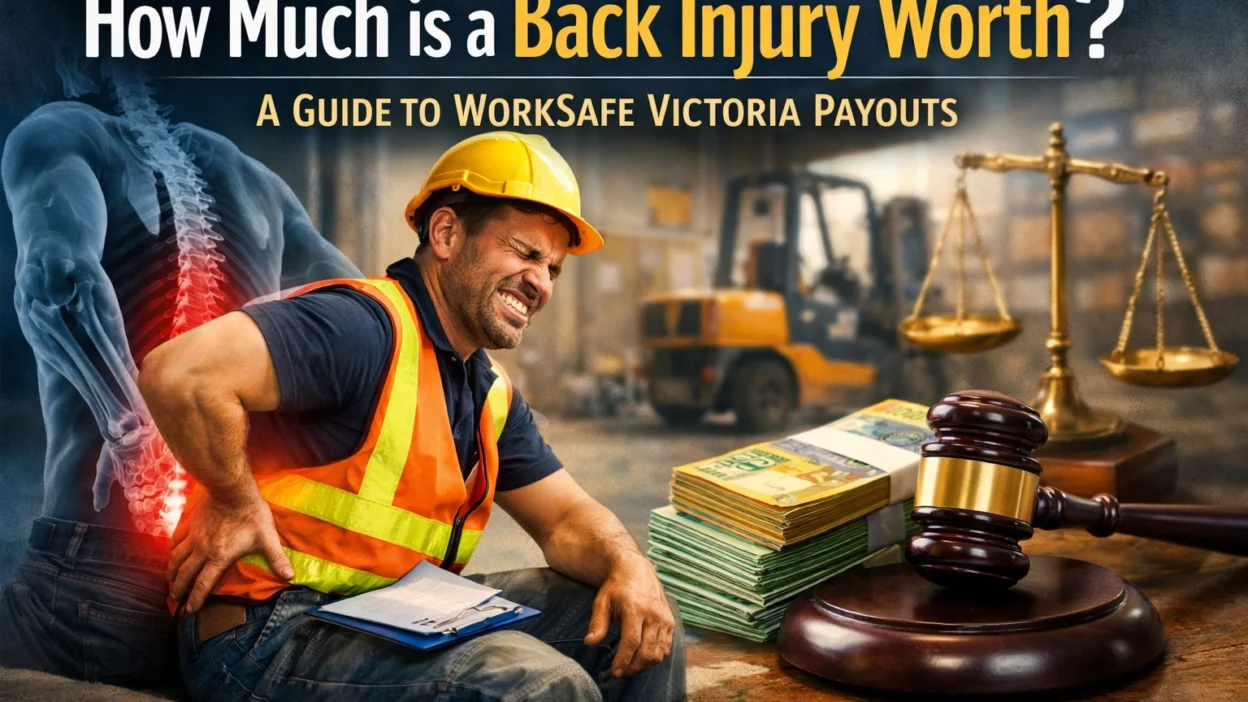
If you’re reading this, chances are your back is stuffed, you’re tired of sitting in waiting rooms, and you’re starting to wonder if the "system" is ever actually going to work in your favour.
Waking up with a back injury is a different kind of stress. It’s not just the physical pain of a bulging disc or a strained lumbar; it’s the mental weight of wondering how you’re going to pay the mortgage if you can’t get back on the tools or into the office. You’ve likely spent months dealing with case managers, filling out endless forms, and feeling like you’re just another claim number in a giant filing cabinet.
The question you’re probably asking yourself right now is: “What is all this worth?”
In Victoria, calculating a back injury payout isn't a simple "one-size-fits-all" answer. It’s a combination of different types of compensation, from your weekly wages to lump sum benefits. Let’s break down exactly what you’re entitled to and how the WorkSafe Victoria system actually works: without the confusing legalese.
The Three Main Ways You Get Paid
When people talk about a "WorkCover payout," they’re usually talking about one of three things. Depending on how bad your injury is and how it happened, you might be eligible for one, two, or all three.
- Weekly Payments: This is your regular income while you can't work.
- Impairment Benefits: A "no-fault" lump sum payment for permanent damage.
- Common Law Damages: A larger payout if your employer was at fault and your injury is "serious."

1. Weekly Payments: Keeping the Lights On
First things first: you need to live. If your back injury means you can’t work your normal hours (or any hours at all), WorkSafe is required to pay a portion of your wages.
For the first 13 weeks, you usually get 95% of your pre-injury average weekly earnings (PIAWE). After that, it drops to 80%. There is a cap on this: currently around $2,660 per week: but for most Victorian workers, it’s meant to cover the essentials while you recover.
The "cliff edge" most workers face is the 130-week mark. This is the point where the insurer often tries to cut off your payments by claiming you have "capacity" to work in some other job: even if that job doesn't exist or you aren't qualified for it. Navigating this period is crucial to ensuring you don't end up out of pocket while you’re still hurting.
2. The Impairment Benefit: Your First Lump Sum
This is where things get interesting. An Impairment Benefit is a lump sum payment designed to compensate you for the fact that your back might never be 100% again.
The best part? You don’t have to prove your boss did anything wrong to get this. It’s "no-fault." If you’ve been left with a permanent loss of function, you are likely entitled to it.
How is it calculated?
WorkSafe uses a very specific (and often frustrating) set of guidelines to give you a "percentage" of permanent impairment. For a back injury, a doctor will look at things like your range of motion, whether you’ve had surgery (like a spinal fusion or discectomy), and if there is nerve root damage.
Here is a rough guide to what those percentages look like in terms of actual dollars in Victoria (as of early 2026):
| Degree of Permanent Impairment | Estimated Compensation Range |
|---|---|
| 0 – 4% | $0 |
| 5 – 9% | $14,980 – $25,188 |
| 10 – 19% | $27,740 – $58,847 |
| 20 – 29% | $62,295 – $93,332 |
| 30 – 39% | $96,780 – $151,200 |
| 40 – 49% | $157,250 – $211,700 |
| 50 – 59%+ | $217,750+ |
Note: These figures are indexed annually. The maximum possible impairment benefit is currently over $750,000, though that is reserved for the most catastrophic injuries.
The "Magic" Number for Backs: To get a lump sum for a physical injury in Victoria, you usually need to reach a 5% impairment rating. For many back injuries involving disc bulges or minor surgery, hitting that 5-10% mark is common, but the insurer’s doctors will often try to rate you lower to avoid paying out.

3. Common Law Claims: The "Big" Payout
If your back injury was caused by your employer’s negligence: maybe they didn't provide the right lifting equipment, or they forced you to work in unsafe conditions: you can sue for "Common Law Damages."
This is where the payouts become much more significant. We aren't just talking about $20,000 or $50,000; we are often talking about hundreds of thousands of dollars.
To qualify for a Common Law claim, you need to meet two big hurdles:
- Fault: You have to prove the employer (or a third party) was negligent.
- Serious Injury: You must have a "Serious Injury Certificate." This generally means you have at least a 15% permanent impairment, OR the injury has a "very considerable" impact on your life, your ability to work, and your future.
Common law payouts cover two main areas:
- Pain and Suffering: Compensation for the physical and mental toll the injury has taken on your life.
- Economic Loss: Compensation for the wages you have lost and will lose in the future because you can no longer do your old job.
Average Back Injury Payout: While every case is different, the average back injury payout in Australia involving a successful common law claim often hovers around the $100,000 to $150,000 mark, but can easily climb much higher if you can no longer work in your chosen trade.
Why Back Injuries are Tricky
The reason back injuries are a "favourite" for insurance companies to fight is that they are often "invisible." You can’t see a sore back on the outside like you can a broken leg.
Insurers will often try to argue that:
- Your pain is "pre-existing" (the classic "it’s just age-related wear and tear" excuse).
- You are exaggerating your symptoms.
- You could easily work a desk job (even if you’ve spent 20 years as a brickie).
This is why getting the right assessment is everything. One doctor might say you have a 4% impairment (meaning $0 payout), while another recognises the true extent of the nerve damage and rates you at 12% (meaning a significant payout).

Don't Settle for the Run-Around
The Victorian WorkCover system is designed to be a safety net, but often it feels like a spider web. You get stuck in the fine print, the medical appointments, and the constant back-and-forth with case managers who seem to want to save the company money rather than help you get better.
You shouldn't have to spend your recovery time fighting for crumbs. Whether you’ve just been injured or you’ve been on weekly payments for a year, you deserve to know exactly what your claim is worth.
How to Find Out What You're Owed
You don't need a lawyer to start figuring this out, and you certainly don't need to spend hours reading through government legislation.
At WorkCover Check Australia, we’ve simplified the whole process. We believe every Victorian worker deserves a fair go and a clear answer.
If you want to stop guessing and start getting the benefits you’re entitled to, take our 60-second check. It’s fast, it’s private, and it gives you the clarity you need to move forward.
Check your back injury claim value now at workcovercheck.com.au

Quick Summary: Your Back Injury Checklist
- Are you getting 80-95% of your wages? If not, check your PIAWE calculation.
- Have you been injured for more than 12 months? You should be looking into an Impairment Benefit lump sum.
- Was the injury someone else's fault? You might be eligible for a Common Law claim worth significantly more.
- Is the insurer talking about the 130-week limit? Get advice immediately before your payments are cut.
Your back is the foundation of your body and your ability to earn a living. Don't let an insurance company tell you it isn't worth much. Take control of your claim today.